
What is an Intelligent Agent in AI? Explanation, Types, and Real-Life Examples
Estimated reading time: 7 minutes
Key Takeaways
- An intelligent agent in AI is a system that observes, reasons, and acts in its environment—sometimes even learning as it goes.
- These agents are the building blocks behind modern AI applications like self-driving cars, chatbots, and recommendation systems.
- There are five main types of intelligent agents, ranging from simple reactive machines to complex learning agents.
- Real-world examples include smart assistants, navigation apps, trading bots, and more.
- Understanding how intelligent agents operate is essential for anyone interested in artificial intelligence.
Table of Contents
Introduction
An intelligent agent in AI is like a smart helper that can sense its environment, make decisions, and take actions to achieve goals. Unlike regular computer programs that just follow fixed rules, these AI agents can learn and adapt over time.
Think of them as digital assistants that can work independently to solve problems, much like how humans observe, think, and act in different situations.
In this guide, you’ll discover:
- What intelligent agents are—and how they work
- The different types of AI agents
- Everyday examples of intelligent agents
- Why they’re so important for modern artificial intelligence
What is an Intelligent Agent?
An intelligent agent is a system—software or hardware—that can:
- Observe its environment through sensors
- Process info using reasoning
- Take actions to achieve specific goals
- Learn from experience
For a deeper dive into what makes up an intelligent agent, see components about intelligent agents.
You can also get a quick overview in this simple guide to intelligent agents.
Key Characteristics
- Autonomy: Makes decisions without constant human input
- Reactivity: Responds to changes in real-time
- Proactiveness: Takes initiative to achieve goals
- Learning: Improves performance over time
- Perception: Gathers information from its environment
- Reasoning: Analyzes situations to make decisions
- Goal-oriented: Always working toward specific objectives
Types of Intelligent Agents
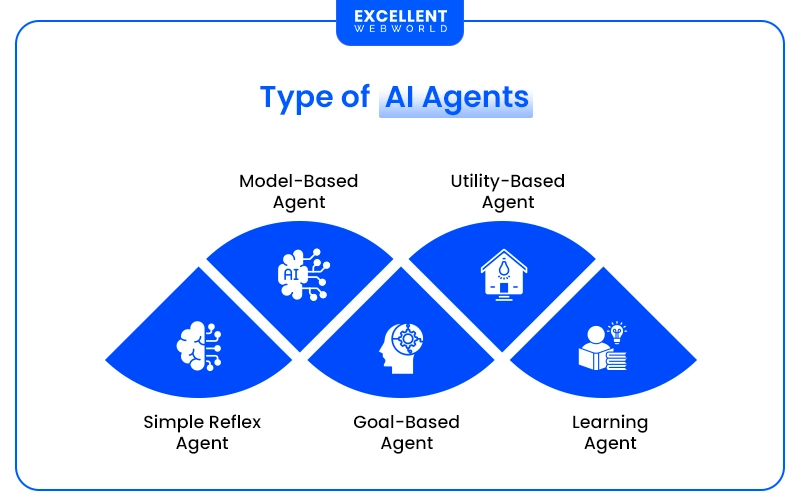
There are five main types of intelligent agents, each becoming more sophisticated:
1. Reactive Agents
– The simplest agents
– Respond directly to the current situation (no memory)
– Example: Thermostat adjusting your room temperature
2. Model-Based Reactive Agents
– Maintain an internal model of their world
– Can remember changes and adapt actions
– Example: Robot vacuum mapping your living space
3. Goal-Based Agents
– Take actions to satisfy defined objectives
– Example: Navigation app finding the best route for you
4. Utility-Based Agents
– Make choices based on value or benefit
– Try to maximize “happiness” or utility
– Example: Stock trading bots optimizing profits
5. Learning Agents
– Continuously improve by learning from experience
– Example: Chatbots getting more helpful over time
Discover additional real-world examples of intelligent agents and learn how multiple agents interact in business scenarios here.
How Intelligent Agents Work
At their core, all intelligent agents follow a sense-think-act cycle:
- Sensing: Collects data from the environment (through cameras, microphones, code, or user input)
- Thinking: Analyzes information & chooses the best action based on its type and goals
- Acting: Makes changes or takes actions in the world
Over time, learning agents analyze the results of their actions to get better at their tasks.
For example: Your email spam filter gets smarter as it sees more spam and legitimate messages.
Real-Life Examples of Intelligent Agents
- Smart Assistants (Alexa, Siri, Google Assistant): Understand your requests, search relevant info, and control devices.
- Navigation Apps (Google Maps, Waze): Calculate fastest routes, reroute on traffic, suggest stops.
- Recommendation Engines (Netflix, Spotify): Suggest movies or songs based on your taste and past choices.
- Trading Bots: Buy and sell stocks automatically, based on algorithms and market analysis.
- Self-Driving Cars: Use sensors and AI to “see” the environment, plan routes, and safely drive.
You encounter intelligent agents almost daily—even if you don’t realize it. Their influence is only growing as technology advances!
FAQ
- What makes an agent “intelligent”?
- Where are intelligent agents used in real life?
- What is an example of an intelligent agent?
- Are intelligent agents the same as AI?
An intelligent agent doesn’t just follow static rules—it can perceive its environment, make decisions, act autonomously, learn, and adapt.
Everywhere! From chatbots and personal assistants to self-driving cars, recommendation systems, and even logistics warehouses.
Google Maps is a classic example—it senses traffic, plans the best routes, and adapts as you travel.
Not exactly. AI is a broad field; an intelligent agent is a fundamental concept within AI that emphasizes autonomy and goal-oriented behavior.