
AI Automation Tools and AI Orchestration: A Complete Guide
Estimated reading time: 8 minutes
Key Takeaways
- AI automation tools streamline complex business tasks, increasing productivity and reducing costs.
- AI orchestration ensures multiple automation tools work seamlessly together across your processes.
- Selecting the right tool requires an assessment of features, integration, scalability, and costs.
- Real-world results include faster response times, fewer manual tasks, and improved data accuracy.
- The right automation approach can transform—not just automate—your entire business.
Table of Contents
What Are AI Automation Tools?
AI automation tools are powerful platforms that use artificial intelligence to handle business tasks automatically. Leveraging machine learning, natural language processing, and computer vision, these tools process, analyze, and act on complex data with minimal human input.
Key capabilities include:
- Processing unstructured data (emails, documents, images)
- Triggering automated workflows [source]
- Learning from patterns to improve performance
- Making decisions based on real-time data
Common uses:
- Automating workflow approvals and notifications [source]
- Analyzing data and creating reports
- Managing customer service inquiries
- Routing IT support tickets
- Processing documents and forms
Business benefits:
- Increased productivity
- Reduced operational costs (up to 35%)
- Improved accuracy (95%+ in data processing)
- Better decision-making through data analysis
- Scalable operations
For detailed examples and industry benchmarks, see this article on AI automation.
What Is AI Orchestration?
While AI automation tools are focused on handling specific tasks, AI orchestration is about coordinating many tools and workflows to deliver seamless, end-to-end process automation. Imagine a conductor ensuring all musicians (AI tools) play together perfectly.
- Manages multiple tools and workflows [source]
- Coordinates complex, multi-step business processes
- Provides enterprise-level oversight and governance
- Adapts as business needs and environments change
AI orchestration enables a business to build flexible, adaptable, and efficiently managed operations. Learn more from Salesforce’s guide on AI automation.
Essential Features of AI Automation Tools
When comparing AI automation platforms, focus on the following features:
- Integration Capabilities
- Connections with your existing apps and services
- API accessibility
- Pre-built integrations
- Scalability
- Cloud-based infrastructure
- Handles growing workloads
Performance under pressure [see comparison]
- User-Friendly Interface
- No-code or low-code options
- Visual workflow designers
- Pre-built templates for smart workflows
- Security and Compliance
- Data encryption
- Regulatory compliance
- Audit trails for transparency
Explore in-depth overviews and feature lists in this guide to top AI tools for business automation.
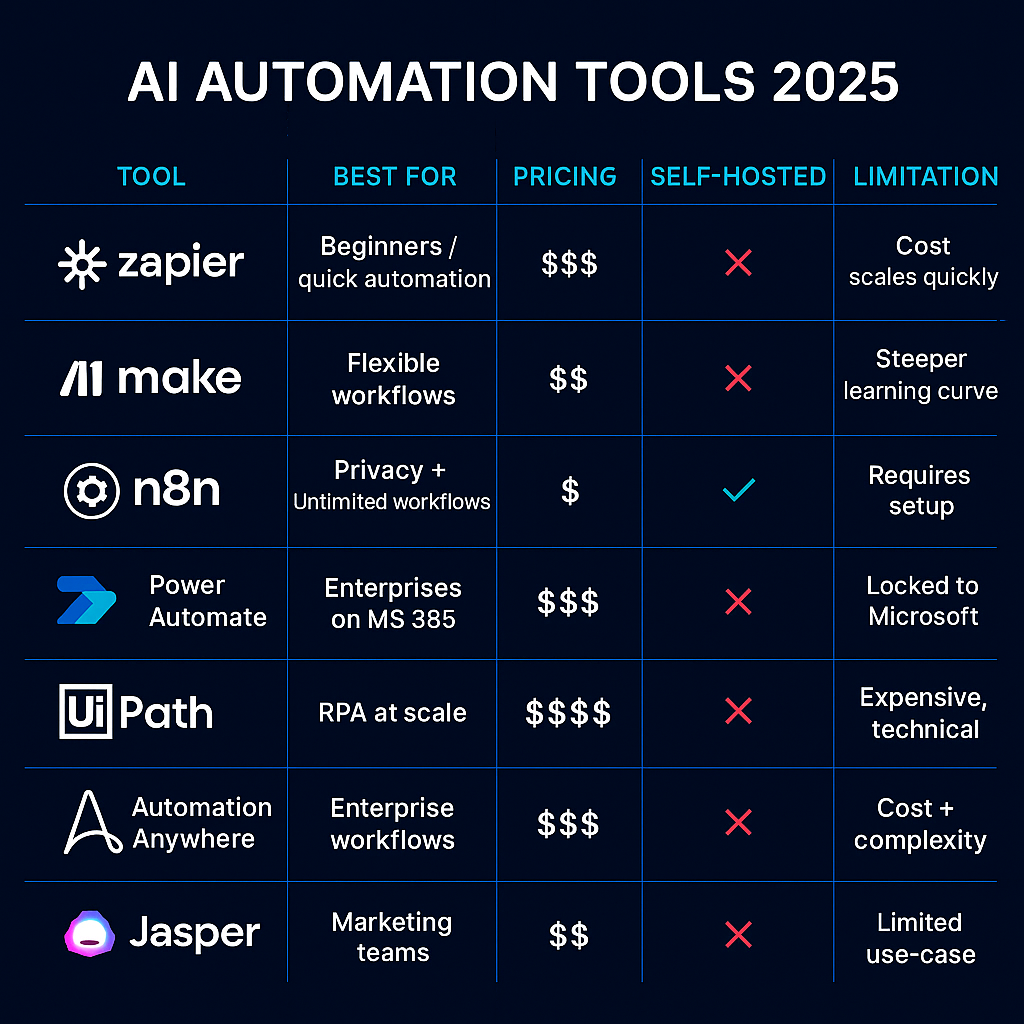
Popular AI Automation Tools
There are dozens of tools available; here are a few of the most widely-used:
Workflow Automation
- Microsoft Power Automate
- Zapier
- Make (formerly Integromat) [detailed comparison]
Customer Service
- Microsoft Copilot
- Intercom
- Freshdesk AI
Data Analysis
- Power BI
- Tableau
- ThoughtSpot
Enterprise Solutions
- ABBYY
- UiPath
- Salesforce
- Creatio
Find more use cases and product overviews from UiPath’s AI automation hub.
How to Choose the Right Tool
Choosing the ideal automation or orchestration solution for your company involves several important steps:
- Assess Your Needs
- Identify which processes will benefit most from automation
- List key integrations and connections needed
- Define your metrics for success
- Evaluate Features
- Test integration capabilities
- Check for scalability as your business grows
- Review security and compliance features
- Consider Costs
- Upfront investment
- Ongoing subscription and maintenance fees
- Training requirements for staff
- Test Before Committing
- Leverage trial versions
- Start small & iterate [example workflows]
- Gather internal feedback and refine
For a full breakdown of the decision process, read AI vs. Automation: What’s the Difference?
Real-World Success Stories
- 20% reduction in customer service response times
- 35% cost savings in manufacturing operations
- 99% accuracy achieved in document processing
- Cutting manual data entry by thousands of hours annually
These outcomes come from organizations implementing both AI automation and orchestration. For more inspiring case studies, visit Salesforce AI Automation Stories.
Conclusion
*AI automation tools and orchestration are changing how modern businesses operate.* The secret is not just in automating tasks, but in truly transforming every part of your organization—making processes smoother, teams more agile, and decision-making more data-driven.
Start by evaluating your unique workflows, explore several tools, and implement solutions that offer both immediate improvements and the capacity to scale.
As one business leader said:
‘Automation is not about replacing people. It’s about enabling your team to do their best work.’
Choose tools with your broader business transformation in mind—and watch the benefits multiply.
FAQ
What is the difference between automation and orchestration in AI?
Automation handles individual tasks or workflows, often in isolation. AI orchestration coordinates multiple tools and workflows—connecting many processes to create seamless, adaptive operations across your organization.
Which industries benefit most from AI automation tools?
Virtually every industry can leverage automation, but it’s especially popular in finance, healthcare, manufacturing, IT, and customer service.
Can small businesses implement AI automation affordably?
Absolutely! Many platforms offer no-code interfaces, pay-as-you-go pricing, and free trials to help smaller organizations automate without major investments.
Is AI automation secure?
Reputable tools include advanced security features (data encryption, compliance controls, audit logs). Always review security options before implementation.
Where can I learn more?
Check these resources: