
Intelligent Agent in AI: A Comprehensive Guide to Understanding AI Agents
Estimated reading time: 9 minutes
Key Takeaways
- An intelligent agent in AI is an autonomous software system that can perceive its environment, process data, make decisions, and act towards goals.
- These systems can learn from experience and adapt over time, unlike traditional static programs.
- There are five main types of AI agents: simple reflex, model-based reflex, goal-based, utility-based, and learning agents.
- Real-world applications range from digital assistants to industrial automation and autonomous vehicles.
- Growing enterprise adoption is driving emerging solutions and multi-agent systems shaping the future of AI.
Table of contents
What is an Intelligent Agent in AI?
An intelligent agent in AI is a software system that acts autonomously to achieve specific tasks or goals. What sets these agents apart from traditional programs is their ability to:
- Perceive their environment
- Process information and reason independently
- Make informed decisions
- Take actions that further their objectives
- Learn from their own experiences
For a deeper dive, see intelligent agent in AI explained and Google’s overview.
How Intelligent Agents Work
Intelligent agents follow a foundational perceive-think-act loop, generally involving:
- Perception: Gathering data from their environment
- Reasoning: Processing that data and matching it against objectives
- Decision-making: Selecting the best action
- Action: Performing actions to reach their goals
Some agents simply react, while others plan and learn. For practical examples, see intelligent agent in AI (real-world examples) and GeeksforGeeks on intelligent agent in AI.
Types of Intelligent Agents
Intelligent agents come in five main forms, each offering increasing sophistication (source):
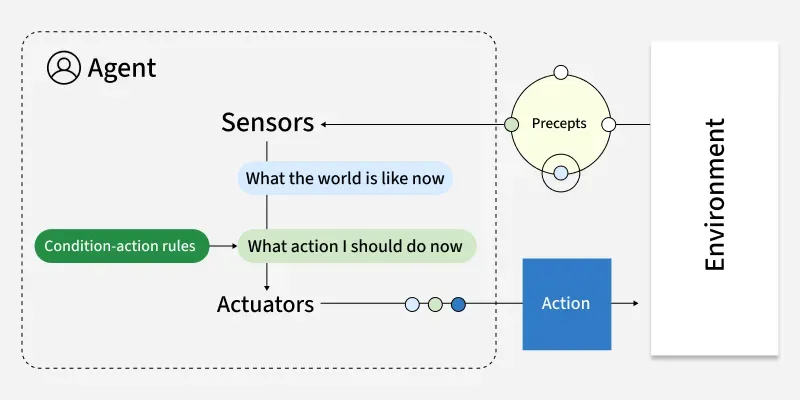
1. Simple Reflex Agents
- Act on condition-action rules
- Offer fast, basic responses
- No awareness of history
2. Model-Based Reflex Agents
- Keep an internal model of the world
- Adapt in partially observable settings
- Update beliefs with new data
3. Goal-Based Agents
- Plan actions strategically to achieve goals
- Use advanced reasoning
- Prioritize outcomes
4. Utility-Based Agents
- Optimize for the best outcomes based on preferences
- Balance competing objectives
5. Learning Agents
- Improve with feedback, adapt to new circumstances
- Continually evolve their behavior
Discover more real-life examples of learning agents.
Explore more on agent types at Rishabhsoft’s guide.
Curious how agents collaborate? Read about multi agent systems and their business impact.
For enterprise-ready solutions, check out OpenAI’s frontier platform.
Real-World Applications of Intelligent Agents
Intelligent agents are reshaping industries. Consider these examples:
- Smart personal assistants (like Siri and Alexa)
- Robotics and manufacturing automation
- Autonomous vehicles
- Financial trading bots
- Enterprise automation systems (see enterprise use cases)
Their ability to adapt and learn is opening doors to solutions that were once science fiction.
FAQ
What makes an agent “intelligent”?
An agent is considered “intelligent” if it can perceive its environment, make decisions autonomously, and improve through learning.
Where are intelligent agents most commonly used?
They power digital assistants, robotics, self-driving cars, financial algorithms, and smart automation in modern enterprises.
How do intelligent agents learn?
Through feedback and data—most often using techniques like machine learning and reinforcement learning to adapt over time.
What’s the future of intelligent agents in AI?
Experts predict more advanced, collaborative multi-agent systems driving enterprise automation and personalized services.
Where can I learn more?
See detailed guides and use cases at mettamotion.com.