
What is an Intelligent Agent in AI? Explanation, How They Work, and Key Examples
Estimated reading time: 7 minutes
Key Takeaways
-
- An intelligent agent is a digital entity that can perceive, decide, and act in its environment.
-
- Key features: independence, adaptability, and continuous learning from experience.
-
- There are five core types, ranging from basic reflex agents to advanced learning agents.
-
- Intelligent agents power technologies like chatbots, self-driving cars, and personal assistants.
- For further reading, see this in-depth overview and this guide to agent types and examples.
Table of Contents
Introduction
An intelligent agent in AI is like a digital worker that can sense its surroundings, make decisions, and take actions to achieve specific goals. Think of it as a smart program that can learn from experience—and work independently, much like a well-trained assistant who doesn’t need constant direction.
In this post, we’ll break down what intelligent agents are, how they function, and some real-world examples that show their impact on today’s technology landscape.
What is an Intelligent Agent in AI?
An intelligent agent is a software program designed to:
- Gather information from its environment
- Process that information independently
- Make decisions based on its findings
- Take actions to achieve specific goals
For an in-depth breakdown of the core components and real-world applications of AI agents, see this resource.
What makes these agents truly intelligent is their ability to:
- Learn from experience
- Adapt to new situations
- Work without constant human supervision
- Improve their performance over time
These capabilities set them apart from regular software programs, which simply follow fixed rules without learning or adapting. For more detail on types, characteristics, and examples, check this explanation.
Types of Intelligent Agents
So, what kinds of intelligent agents are out there? Here are the five main types:
- Simple Reflex Agents: Operate using basic if-then rules; no memory of past actions. Example: A thermostat turning heat on/off based on the current temperature.
- Model-Based Reflex Agents: Track changes by building an internal model of the world, allowing more complex decisions. Example: Self-driving cars monitoring traffic and road signs.
- Goal-Based Agents: Aim for specific outcomes and plan accordingly. Example: Chess AIs determining moves to win the game.
- Utility-Based Agents: Consider the most beneficial action based on multiple factors. Example: Online shopping recommenders choosing what a user might like best.
- Learning Agents: Continuously improve by learning from past outcomes. Example: Chatbots that get better with every conversation.
To see different agent types in practice, visit this illustrated guide.
If you’re interested in how multiple intelligent agents work together in team-like systems on a large scale, check out this introduction to multi-agent systems.
How Do Intelligent Agents Work?
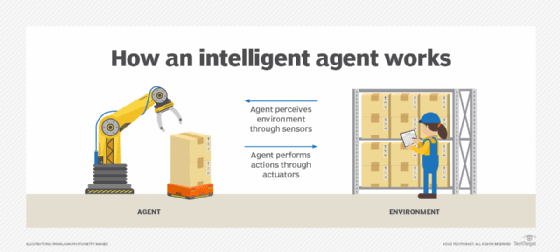
At the core, every intelligent agent continuously follows a sense–think–act loop:
- Sensing: The agent collects data from the environment using sensors or input channels.
- Thinking: It analyzes incoming information using built-in rules, models, or learning algorithms.
- Acting: The agent takes actions—sending commands, responding to users, or changing the environment.
Over time, learning agents use feedback to refine their approach, becoming smarter and more efficient.
“The difference between a basic rule-following bot and a true intelligent agent is the ability to grow and adapt through experience.”
Key Real-World Examples
- Personal digital assistants (like Siri or Alexa): Use natural language processing to answer questions, make reminders, and control smart devices.
- Self-driving cars: Perceive their surroundings and make driving decisions in real-time to reach a destination safely.
- Recommendation systems: Suggest movies, products, or friends by analyzing user behavior and preferences.
- Chatbots: Handle customer queries, learn from interactions, and improve over time.
For a thorough list and discussion of intelligent agent examples across industries, refer to this guide.
FAQ
-
- What makes an agent “intelligent” rather than just automated?
Intelligent agents can learn from experience and adapt behavior, while automated agents typically follow set rules without learning.
- What makes an agent “intelligent” rather than just automated?
-
- Where are intelligent agents used most today?
Most commonly in virtual assistants, recommendation systems, autonomous vehicles, and AI chatbots.
- Where are intelligent agents used most today?
-
- How do intelligent agents improve themselves?
They use techniques like machine learning and feedback from the environment to refine their decision-making and behavior over time.
- How do intelligent agents improve themselves?
- Can intelligent agents work together in teams?
Yes! Multi-agent systems involve several agents collaborating to solve complex problems. Learn more here.